
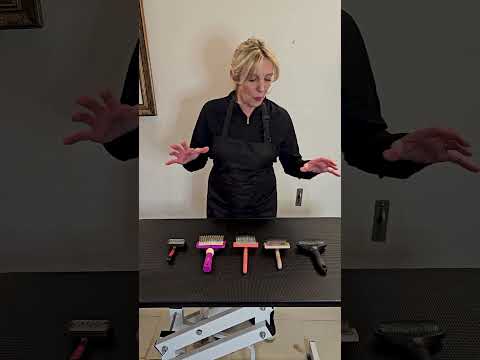
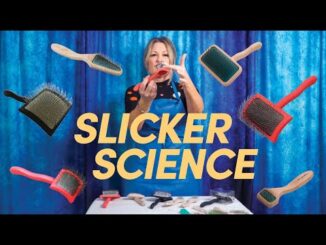
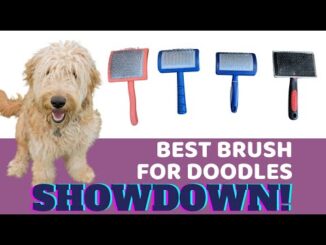
Confused about slicker brushes? Learn how to choose the right slicker brush for your dog’s coat type in this complete grooming guide.
We cover:
– Different slicker brush sizes and shapes
– Soft vs hard pins and what they’re used for
– Pin density, length, and coated vs non-coated pins
– Curved vs flat brush heads and ergonomics
Slicker brushes are essential tools for dematting, deshedding, and maintaining longer-coated dogs.
If you know that you need a Slicker Brush for brushing your coated breed, you may find a lot of options available to you (and if you have any questions on other options, please take a peek at our short on What Kind of Brush You Should Use on Your Pet: And please don’t mistake our use of the term “pin” or “pins” to mistake a slicker brush for a Pin Brush. The two are different, where Pin Brushes have much more rigid pins spaced farther apart, and are used mostly for flowing long coats. The Slicker Brush has densely packed wiry pins to use for dematting, deshedding, and general maintenance brushing of longer-coated dogs.
Let’s go over the different variables that you may find in slicker brushes, but please stay tuned for more follow-up videos where we demonstrate how to properly use each type of slicker brush:
Variable
#1 – Size It’s handy to have a small brush to work around tiny pets and smaller areas (like the face).
#2 – Shape – Common shapes for slicker brushes are Round, Oval, Square, Rectangular and (sometimes) Triangle. I tend to float in the Oval, Square and Rectangle space – but this is really a personal preference.
#3 – Firmness of Pins – You will find Hard or Soft Pin options. The rule of thumb here is that hard pins work great for pulling out tangles or dead coat, while the soft pins are better for pets with sensitive skin. Flexible, soft pins can actually work well in absorbing any shock in dematting for thinner coats.
#4 – Density of Pins – the number of pins per square whatever [insert your local measuring schema] will determine how well a brush can deshedd. Thicker coats (think Arctic Coat) may do better with a brush with denser pins.
#5 – Length of Pins – The length of pins should be somewhat relative to the length of coat you are working with – but that being said, you can absolutely use a short-pinned slicker brush to work with a long coat, like a Maltese. The pin length seems to be more focused on deshedding dogs with thick double-layer coats.
#6 – Coated or Non-Coated Pins – Most slicker brushes come in the non-coated pin variety. But I have to tell you, coated pins are a miracle when working on special-needs pets, especially around their faces and eyes (you still have to be careful!) And they are surprisingly good at dematting. Here’s the little coated-pin guy that I use on the daily:
#7 – Shape of the Head (when looking from the side) – Some slicker brushes are flat, and some curve in an arc. The arc is designed to maximize the efficacy of the natural movement of our hands and wrists.
#8 – Ergonomics – Shape and Feel of the handle – Having a tool that feels good in your hand makes the work more pleasurable! Keep that in mind when choosing your slicker brush – because it will matter, and the right feel will inspire you!
And two variables that I didn’t have enough time to mention, but they are important!:
#9 – Shape of the Pins – you can have straight or bended pins, with the bended pins making a huge difference in usage, especially where the bend is placed in the pins. The bend will catch more dead hair – very helpful with deshedding or dematting.
#10 – Head Flexibility – If the head moves during brushing, it seems to reduce the impact to the pet being brushed. Thus, some of the force that you may encounter when hitting a matted or tight area is absorbed by the moving head. Pretty cool. Take a look at Les Pooches (expensive, I know!) or even better, Jelly Pet or
Hope this helps – we’ll talk more about this subject for sure! Thanks for watching!
Help keep the treats coming—for me and the pups! ☕🐾
buymeacoffee.com/ginasgrooming
💡🐶 “Expert tips, trusted tools, and happy tails!”
Ginasgrooming.com
#doggrooming #dogbrush #petgrooming
Which brush is the best for the Papillon’s hair? Thank you
What about for a caucasian shepherd?
Ok, it does not help with no info on each brush for the type of dog
What type of slicker brush for an Australian Shepherd?
I have a few brushes for my cockerpoo but there are scratchy?